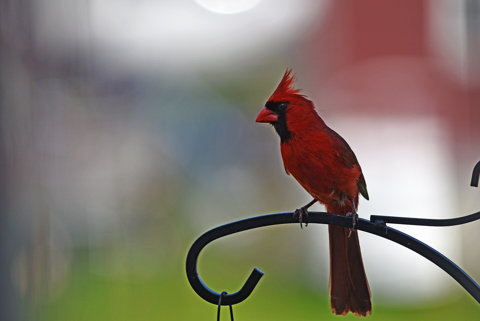
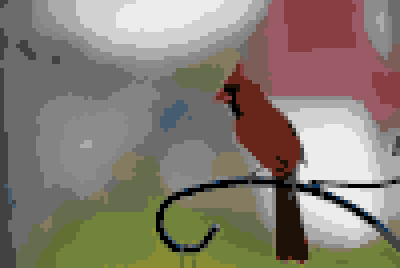
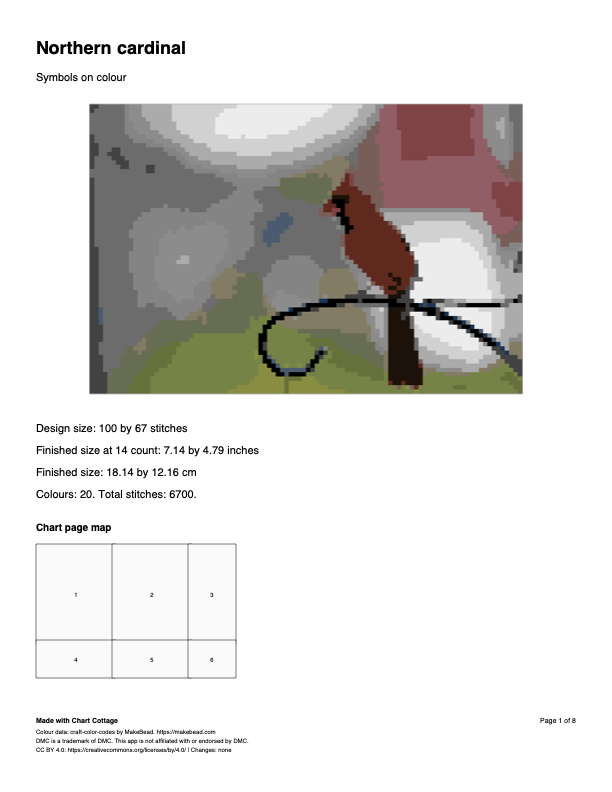

Estimate each colour separately
A stitch total for the whole chart does not tell you how many skeins of each shade to buy. Use the count for one colour at a time. Round that colour's result up to a whole skein, then repeat for the next colour. A little leftover red cannot fill a shortfall in grey.
The measured cardinal has 6700 full stitches and 20 colours. Its thread list totals 20 whole skeins when each shade is rounded up. That is a shopping estimate, not a claim that the pattern consumes every metre you buy.
A worked row from the cardinal
The first row is DMC 168, Pewter Very Light, with 434 stitches. At 14 count and 2 strands, its measured estimate is 9.524568443260359 metres of individual strand, or 0.1984285092345908 skeins. Round up to 1 skein to buy. The calculator starts with that row.
What goes into the calculation
Fabric count means stitches per inch here. The length of one square's side is 2.54 divided by the count, in centimetres. The full-cross path uses two diagonals on the front plus two side lengths. Multiply that path by the stitch total, add 20 percent for waste and 20 cm for tails, then multiply by the number of strands.
Divide the resulting strand length by an 8 metre skein with 6 strands. That gives a fraction of a skein. The buying figure is the next whole number. This assumes you can separate and use the strands; it does not treat eight metres of six-strand floss as eight metres of single strand.
Skeins for one thread colour
Full cross stitches only. Enter stitches per inch as fabric count. Uses the waste and tail allowance above.
Leave room for your stitching method
Long carries, restarting thread and pulling out mistakes can use more than this allowance. Backstitch is not included in this small calculator. Neither are unusual stitch types. Use the pattern's own supply advice when it accounts for those extras.
On evenweave, enter the effective stitch count, not just the fabric's thread count. Stitching over two fabric threads makes fewer crosses per inch. Keep all skeins for one shade together and label them before starting, so leftovers from a similar colour do not get mixed into the project.